
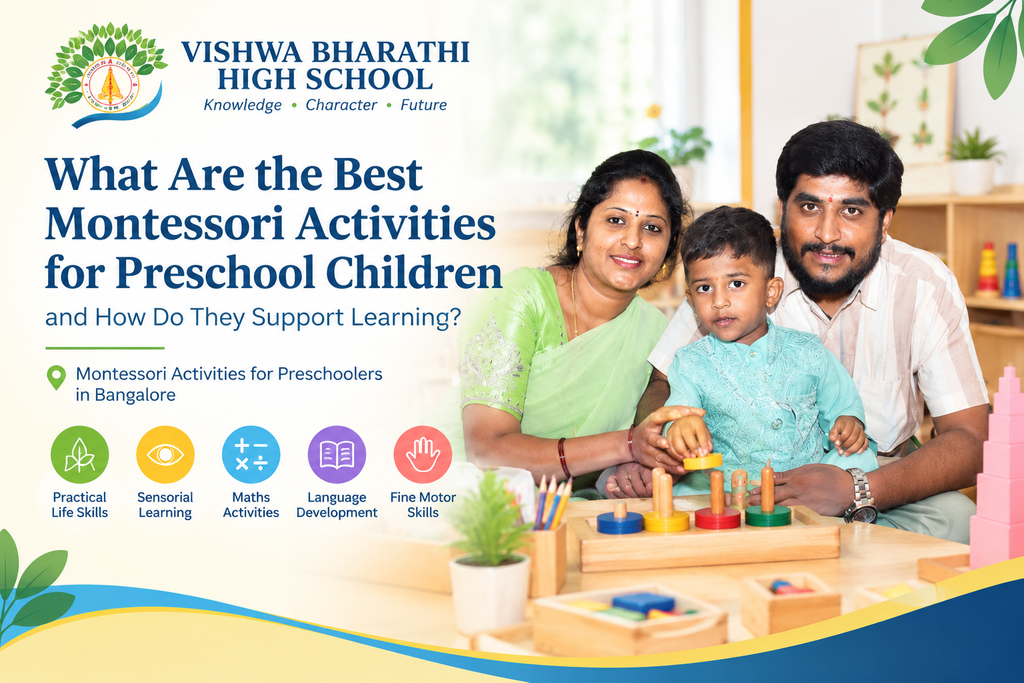
Young children are naturally curious, absorbing information from their surroundings at a remarkable pace. They explore their world by touching, moving, and testing the objects around them. During these crucial early years, practical, hands-on learning activities for preschool children can channel this innate curiosity into foundational skills and healthy, lifelong learning habits.
If you are exploring Montessori activities for preschoolers in Bangalore, understanding how these hands-on exercises work is the first vital step. Modern parents are increasingly seeking holistic educational approaches, and this guide covers the core areas of early learning: practical life, sensorial exploration, maths, language, and fine motor skills. We will also share simple, accessible activities you can try at home. While every child develops at their own unique pace and no single method guarantees academic perfection, these Montessori activities for preschoolers provide meaningful, structured opportunities to practise physical coordination, independence, and deep concentration.
One-Minute Summary: Key Montessori Activities for Preschoolers
Here is a quick overview of common activity categories, simple examples of what they entail, and the learning opportunities they provide for young minds. Note: These are general examples of the broader Montessori approach, rather than a verified list of activities currently delivered at Vishwa Bharathi High School.
| Activity Type | Example | Learning Opportunity |
| Practical life | Pouring water between small containers | Coordination and task completion |
| Sensorial | Sorting objects by colour or size | Observation and comparison |
| Early maths | Counting everyday objects | Number awareness |
| Language | Matching pictures with familiar words | Vocabulary development |
| Fine motor | Threading large beads under supervision | Hand-eye coordination |
Table of Contents
- What Are Montessori Activities for Preschool Children?
- Which Montessori Activities Are Best for Preschoolers?
- How Do Montessori Activities Help Children Learn?
- Montessori Activities for 3-Year-Olds and 4-Year-Old Children
- Which Montessori Activities Can Children Do at Home?
- How Can Parents Choose Age-Appropriate Montessori Activities?
- Montessori Activities in Bangalore: What Parents Should Look for in a Pre-Primary Programme
- Frequently Asked Questions
Montessori activities for preschoolers are purposeful, hands-on tasks thoughtfully designed to match a child’s specific developmental stage. Rather than relying on passive listening or rote memorisation, these activities require active child participation, physical repetition, and careful observation.
The primary purpose of these structured tasks is to allow children to explore concepts physically before they are expected to understand them abstractly. An activity offers a self-contained opportunity to practise a skill at their own pace, whether that is categorising geometric shapes, safely pouring a glass of water, or identifying letter sounds. Because tasks are scaled exactly to the child’s current physical and cognitive abilities, they naturally encourage independent problem-solving and intrinsic motivation. To understand more about the broader philosophy and structured environment behind these methods, read our comprehensive guide on how Montessori education supports early childhood learning.
The most effective activities isolate a single concept or skill, allowing the young child to focus and practice without being overwhelmed by multiple demands. Here is a detailed look at the core learning categories.
Montessori Practical Life Activities for Preschoolers
Practical life exercises directly mirror daily adult tasks, carefully scaled down for small hands using child-sized tools.
- Examples: Transferring dry beans or lentils using a small spoon, pouring water between small ceramic pitchers, sorting and putting away everyday items on low shelves, or carefully folding small hand towels corner-to-corner.
- Learning Opportunity: These practical tasks offer opportunities to practise fine motor coordination, logical sequencing (understanding the clear beginning, middle, and end of a task), and foster a deep sense of independence and self-care in daily life.
Montessori Sensorial Activities for Preschoolers
Sensorial tasks help children refine their five senses, enabling them to better navigate and make sense of their physical environment.
- Examples: Sorting wooden blocks by specific colour gradients, size, or shape; comparing fabrics with distinctly different textures (rough, smooth, soft); matching hidden pairs of objects by their weight or the sound they make when shaken; arranging objects from narrowest to widest or smallest to largest.
- Learning Opportunity: These activities strongly encourage close observation, visual discrimination, comparison, and the early classification skills heavily relied upon for future scientific and mathematical thinking.
Montessori Maths Activities for Preschool Children
Maths in the early years is effectively introduced through tangible, manipulatable objects rather than abstract numbers written on a page.
- Examples: Counting familiar, physical objects like pebbles, wooden spindles, or buttons; matching physical wooden numerals to corresponding groups of objects; sorting items into equal groups; and comparing quantities to understand concepts such as “more,” “fewer,” and “zero.”
- Learning Opportunity: Children build a highly concrete awareness of exact quantity and number sequence, bridging the gap between counting aloud and understanding what those numbers actually represent.
Montessori Language Activities for Preschoolers
Language development in this framework focuses heavily on organic vocabulary building, phonetic awareness, and confident self-expression.
- Examples: Matching distinct picture cards to familiar physical objects, naming household objects and verbally describing their physical features in detail, listening to and then retelling a simple story in sequence, and exploring letter sounds through age-appropriate, tactile games.
- Learning Opportunity: These engaging activities seamlessly support rapid vocabulary expansion, proper articulation, and the foundational pre-reading skills necessary for eventual literacy.
Montessori Activities to Develop Fine Motor Skills
Fine motor activities specifically target and strengthen the small muscles in the hands, fingers, and wrists.
- Examples: Threading large wooden beads onto a stiff shoelace (with close supervision), placing large objects into exactly matching slots or containers, using child-safe kitchen tongs to transfer soft items like cotton balls, and drawing simple, continuous shapes in a shallow tray of sand.
- Learning Opportunity: Practising highly controlled hand movements directly supports the hand-eye coordination strictly required for later complex tasks like gripping a pencil for writing, using scissors, and tying shoelaces.
(Note for parents: When visiting a prospective preschool, always look for original photographs or politely ask to see the physical materials used for these learning demonstrations in the classroom environment. Avoid relying solely on stock imagery.)
The physical, self-directed nature of these tasks provides unique developmental benefits, creating an exceptionally strong foundation for future academic and social skills.
How Montessori Activities Encourage Independence
By practising manageable, real-world tasks, children quickly learn to do things for themselves. Choosing an activity from a shelf, completing it at their own pace, and putting the materials away precisely where they belong fosters an incredible sense of responsibility, spatial order, and self-trust.
How Hands-On Activities Support Concentration and Problem-Solving
Hands-on learning activities for preschool children are naturally engaging because they cater to a child’s desire to move and do. Children can observe a problem, try different physical approaches, and repeat tasks as many times as they wish until they succeed. Many materials are designed to be “self-correcting”, meaning the child can see if they made a mistake without an adult needing to point it out. This trial-and-error process builds an impressive attention span and early problem-solving resilience.
How Montessori Activities Support Early Language and Maths Skills
Physical interaction grounds highly abstract concepts firmly in reality. Object naming, sorting, counting, matching, and describing are the fundamental building blocks of literacy and numeracy. By physically holding and counting four individual blocks, a child intuitively and permanently understands the concept of “four” much better than just seeing the numeral “4” written on a whiteboard.
While all children develop at their own individual rates, activities can generally be tailored to fit standard developmental milestones and shifting attention spans.
Safety Note: Always directly supervise activities involving water, glass, tools, or food. Strictly avoid materials and small pieces that present potential choking risks for young children.
Simple Montessori Activities for 3-Year-Olds
At three years old, children are rapidly refining their gross and fine motor coordination while experiencing an explosion in their vocabulary.
- Sorting large, distinct objects by bright primary colours.
- Matching exact pairs of familiar, culturally relevant picture cards.
- Simple pouring activities using dry, easily swept goods (like rice or dry pasta) with supervision.
- Naming and categorising everyday household objects by their room (e.g., kitchen items vs. bathroom items).
Montessori Activities for 4-Year-Old Children
Four-year-olds possess greater manual dexterity and are often ready for multi-step tasks requiring deeper, sustained concentration.
- Sorting items by multiple, complex criteria simultaneously (e.g., sorting by colour and specific shape).
- Counting small, diverse groups of objects and correctly matching them to physical cut-out numbers.
- Sequencing familiar, multi-step daily routines (like the exact steps to wash hands or set a small table).
- Picture-based storytelling to build narrative sequencing skills and imaginative expression.
You absolutely do not need to buy expensive, specialised educational materials to successfully bring these powerful learning concepts into your own living room.
Easy Montessori Activities to Do at Home
- Sorting: Have your child sort clean household objects, such as matching pairs of socks from the fresh laundry or separating safe, blunt utensils into their proper drawer compartments.
- Counting: Count fruit, large vegetables, or other safe, everyday items out loud together during daily meal prep.
- Tidying: Encourage helping with simple, designated tidying tasks, giving them full ownership of maintaining a small space, such as a low bookshelf or a toy bin.
- Textures: Explore physical textures using safe, familiar household materials like rough cardboard boxes, smooth silk scarves, or bumpy corrugated packing paper.
How Can Parents Set Up a Simple Learning Activity?
Start by preparing a safe, uncluttered workspace, ideally at a child-sized table or a designated mat on the floor. Present the materials in an organised tray or basket. Demonstrate the task slowly, deliberately, and silently so the child can focus entirely on your specific hand movements rather than your words. Allow the child to try the task at their own pace, offering gentle help only when they explicitly ask for it or become deeply frustrated.
Selecting the right activity prevents unnecessary frustration and keeps the child highly engaged. Use this practical, parent-focused checklist:
- Is the task suitable for the child’s current physical dexterity and cognitive abilities?
- Are the materials entirely safe, manageable, and suitably sized for their hands?
- Does the activity have a clear, simple purpose with a defined beginning and end?
- Can the child confidently try the task independently with an appropriate level of adult support?
- Is there room to naturally repeat, expand, or adapt the activity as they grow more proficient?
- Does the activity directly align with what currently interests the child (e.g., if they love water, focus on pouring activities)?
Understanding how to match activities to your child’s specific developmental needs is very similar to what parents should consider when choosing a school in Bangalore.
When carefully evaluating a Montessori preschool in Bangalore or a Montessori pre-primary school in Bangalore, it is incredibly helpful to look beyond the marketing brochures and ask highly specific questions about their daily routines.
Parents should proactively ask prospective schools about:
- The exact types of practical and hands-on activities used daily in the classrooms.
- How activities are carefully selected and rotated to match a child’s specific age and evolving learning stage.
- How teachers physically introduce, demonstrate, and supervise these activities without interrupting the child’s flow.
- How the programme systematically supports foundational learning to ensure true primary school readiness.
- How parents are kept consistently informed and engaged regarding their child’s learning progress.
Montessori-Based Pre-Primary Education at Vishwa Bharathi High School
Vishwa Bharathi High School offers a robust, thoughtfully structured Montessori-based pre-primary education in Bangalore, comprehensively covering the BN, LKG, and UKG years. Our curriculum focuses intently on building a strong, activity-based early-learning foundation that successfully prepares young minds for a confident, seamless transition into formal schooling. For more details on how to join our community, please review the Vishwa Bharathi High School Admission Process.
1. What are the best Montessori activities for preschoolers?
The most effective activities isolate a single skill and rely heavily on hands-on exploration. Strong examples include pouring and transferring (practical life), sorting objects by size or colour (sensorial), and counting physical items (maths).
2. How do Montessori activities help children learn?
They allow young children to grasp highly abstract concepts through direct physical interaction. Engaging in repetitive, hands-on tasks provides vital opportunities to develop deep concentration, problem-solving skills, and essential fine motor coordination.
3. Which Montessori activities are suitable for 3-year-olds?
Three-year-olds benefit most from simple, one-step tasks that yield an immediate result. Excellent options include sorting large, colourful objects, matching picture cards, naming everyday household items, and simple pouring exercises (using dry materials like beans).
4. Can parents do Montessori activities at home?
Yes, quite easily. Parents can utilize everyday household items to create immensely valuable learning moments. Matching clean socks, counting fruit in the kitchen, and helping wipe a low table are excellent, low-cost activities that foster independence.
5. How do Montessori activities develop independence?
Tasks and tools are deliberately scaled to the child’s size and ability, allowing them to comfortably complete full cycles of work, choosing an activity, executing it from start to finish, and tidying up, with minimal to no adult intervention.
6. What should parents look for in a Montessori preschool in Bangalore?
Parents should actively look for a safe, structured environment where teachers gently guide rather than lecture. Always ask how hands-on activities are chosen for different age groups and how the school actively tracks and communicates early learning progress to parents.
Montessori activities for preschoolers offer a highly thoughtful, profoundly practical approach to early childhood education. By engaging a child’s natural, biological desire to touch, move, and organise their environment, activities across practical life, sensorial exploration, early maths, and language provide a remarkably rich foundation for lifelong learning. The absolute key to success is choosing activities that perfectly suit each child’s unique age, current interests, and physical abilities.
If you are currently seeking Montessori activities for preschoolers in Bangalore within a safe, structured, and nurturing school environment, we invite you to explore the Montessori-based pre-primary programme for BN, LKG, and UKG at Vishwa Bharathi High School. Contact our admissions team today to learn more about our dedicated early learning approach and secure your child’s foundation.
Planning your child’s school journey?
Explore Vishwa Bharathi High School’s programmes and admission information to understand the learning environment, curriculum, and options available for your child.
Explore Vishwa Bharathi High School admission
Contact Us Now: +91-9481416904
Visit Our Campus: https://maps.app.goo.gl/orHKK7sWQ7cnLf647
Read Reviews: https://share.google/YmC9Xmz5TjnRwNdmu