
Choosing an early learning approach is an important decision for parents. At this stage, children are developing their first learning habits, social skills, communication, and independence. This is why many parents consider Montessori education when looking at options for their young child.
Montessori learning gives children opportunities to learn through hands-on activities, explore concepts at their own pace, and take part in simple everyday tasks. Instead of focusing only on what children need to remember, the approach encourages them to observe, practise, make choices, and learn through experience.
But what are the actual benefits of Montessori education for young children? From developing independence and concentration to supporting problem-solving, communication, confidence, and social skills, Montessori learning can contribute to several areas of early childhood development. This guide explains the key benefits of Montessori education and what parents should consider when deciding whether this approach is suitable for their child.
At a Glance: Benefits of Montessori Education
| Benefit | How it can support children |
| Independence | Encourages children to participate in age-appropriate tasks |
| Concentration | Provides opportunities for focused, purposeful activities |
| Problem-solving | Encourages children to explore and work through challenges |
| Confidence | Builds confidence through independent participation and achievement |
| Practical skills | Connects learning with everyday activities |
| Social development | Encourages cooperation, respect, and interaction |
| Creativity | Gives children opportunities to explore and express ideas |
| Communication | Supports language development and interaction |
Table of Contents
- What Is Montessori Education?
- What Are the Main Benefits of Montessori Education?
- How Montessori Education Supports Cognitive Development
- How Montessori Learning Builds Independence and Responsibility
- How Montessori Education Supports Concentration and Focus
- How Montessori Learning Develops Problem-Solving Skills
- How Montessori Supports Social and Emotional Development
- How Montessori Education Encourages Practical Life Skills
- How Montessori Learning Supports Creativity and Communication
- Is Montessori Education Good for Young Children?
- Montessori Education and Early Childhood Development
- Montessori Education for Young Children in Bangalore
- Montessori-Based Pre-Primary Education at Vishwa Bharathi High School
- Frequently Asked Questions
- Conclusion
What Is Montessori Education?
Understanding the Montessori Method
Developed by Dr. Maria Montessori, the Montessori Method is a child-centred learning framework. It provides a prepared learning environment where children engage in self-directed activities. Through hands-on learning, children explore physical concepts to build foundational knowledge. The teacher acts as a facilitator, observing the child and introducing new materials when the child demonstrates readiness, which supports guided independence.
How Montessori Learning Differs From Conventional Early Education
Conventional education often utilizes teacher-led instruction where children progress at a uniform learning pace. In contrast, the Montessori approach allows for an individual pace. Instead of relying on direct instruction, teachers guide children toward hands-on materials. This emphasis on classroom participation and independence provides children with opportunities to learn through active experimentation.
Explore our detailed guide to understand how Montessori education supports early childhood learning.
What Are the Main Benefits of Montessori Education?
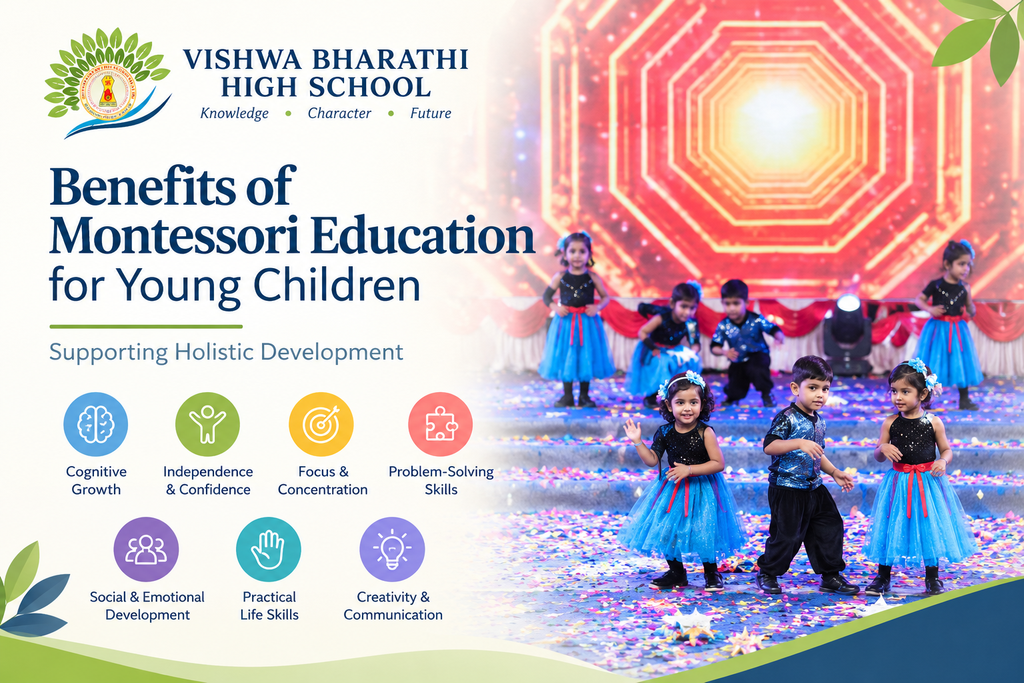
The benefits of Montessori education can include opportunities to develop independence, concentration, problem-solving, practical skills, communication, confidence, and social-emotional abilities. Through hands-on activities and guided learning, children can participate actively in age-appropriate tasks while developing skills at their individual pace.
Independence and Responsibility
The environment provides choices, allowing children to manage their daily routines and develop self-reliance.
Concentration and Focus
Uninterrupted work cycles offer children the time necessary to develop sustained attention on specific tasks.
Problem-Solving Skills
Self-correcting materials encourage children to use reasoning and trial-and-error to reach conclusions.
Social and Emotional Development
Mixed-age classrooms provide opportunities for peer mentorship, empathy, and social cooperation.
Practical Life Skills
Everyday tasks connect classroom learning with home life, building motor coordination and capability.
Confidence and Self-Discipline
Mastering tasks independently gives children opportunities to build internal self-assurance.
Creativity and Curiosity
Open exploration allows children to follow their natural interests and express ideas clearly.
Communication and Language Skills
Peer interaction and vocabulary exercises support active language development.
How Montessori Education Supports Cognitive Development
How does Montessori education help child development?
Montessori education supports cognitive development by providing opportunities to link physical movement with cognitive tasks. By engaging with tactile materials, children practice observation, reasoning, and analytical skills. This approach allows cognitive development to progress as children explore concepts matching their individual readiness.
Encouraging Observation and Exploration
A prepared environment contains varied learning materials. As children select these materials, they observe differences in size, shape, volume, and texture. This learning through exploration lays the groundwork for scientific thinking and categorization.
Supporting Problem-Solving and Reasoning
Montessori materials are mathematically precise. When a child works with sequence blocks or sorting beads, they use reasoning to determine spatial relationships. This physical interaction grounds their analytical abilities before they encounter abstract mathematics.
Learning Through Hands-On Experiences
Abstract concepts can be challenging for young children to process without physical context. Hands-on learning provides this context. By physically holding objects that represent numeric values, children have the opportunity to comprehend mathematics on a tangible level.
How Montessori Learning Builds Independence and Responsibility
Does Montessori education help children become independent?
Yes, the learning environment is designed to provide children with opportunities to make choices, manage age-appropriate tasks, and take responsibility for their personal care. This freedom to self-direct learning helps children gradually develop self-reliance and responsibility.
Encouraging Children to Complete Age-Appropriate Tasks
In a Montessori setting, furniture and learning materials are child-sized. This design enables children to engage in age-appropriate activities, such as organizing a workspace or preparing a snack, without requiring continuous adult intervention.
Developing Responsibility Through Choice and Routine
Children are granted the freedom to choose their work. With this choice comes the responsibility to complete the activity and return the materials to their designated place. This routine establishes a natural sense of order and personal accountability.
How Montessori Education Supports Concentration and Focus
Purposeful Activities and Sustained Attention
When children select activities that align with their developmental interests, they are more likely to engage deeply. The Montessori method utilizes these purposeful activities to help children practice sustained attention.
Allowing Children Time to Explore and Practise
Montessori environments typically utilize an uninterrupted work cycle. This schedule provides children with the time necessary to explore materials, recognize errors, and try again, which is an essential condition for developing concentration.
Developing Focus Through Repetition and Practice
Young children learn effectively through repetition. The independent learning environment allows children to repeat tasks as often as they choose. This practice provides a method for mastering skills and building mental focus.
How Montessori Learning Develops Problem-Solving Skills
How does Montessori learning improve concentration and problem-solving skills?
Montessori learning improves these skills by using self-correcting educational materials. When children encounter an error, the materials encourage them to use reasoning and critical thinking to find solutions independently, rather than relying on a teacher for the answer.
Encouraging Children to Explore Solutions
Teachers encourage independent thinking by prompting children to observe their work. If an activity does not yield the expected result, the guide helps the child explore alternative methods, fostering an analytical mindset.
Learning Through Trial, Observation, and Practice
Through trial, error, and observation, children learn that mistakes are steps in the learning process. This understanding encourages further experimentation and reasoning.
How Montessori Supports Social and Emotional Development
Learning to Work With Others
Social and emotional development is supported by mixed-age classrooms. Younger children observe older peers, while older children can practice patience by assisting the younger ones. This structure encourages cooperation and social interaction.
Developing Respect and Responsibility
Children learn to respect shared workspaces. If a peer is working with a material, other children are taught to navigate around them carefully. This practice builds emotional awareness and respect for community guidelines.
Supporting Communication and Emotional Awareness
Teachers model polite communication and guide children on how to express feelings constructively. Lessons in grace and courtesy are integrated into the curriculum to support communication skills in group settings.
How Montessori Education Encourages Practical Life Skills
What Are Practical Life Activities?
Practical life activities represent everyday tasks. These include care of the person, care of the environment, and social courtesies.
How Everyday Tasks Support Learning
These learning tasks require fine motor coordination and logical sequencing. For example, cleaning a workspace requires fetching supplies, scrubbing, rinsing, and drying. This sequence provides opportunities to build coordination and memory.
Connecting Practical Skills With Independence
When children manage their own practical tasks, their reliance on adults decreases. These practical life skills directly support a child’s progression toward physical self-sufficiency.
How Montessori Learning Supports Creativity and Communication
Encouraging Curiosity and Exploration
Because the learning approach is flexible, children can follow their natural curiosity. If a child shows interest in a specific subject, they have the time to explore it thoroughly, fostering a natural inclination for discovery.
Opportunities for Creative Expression
The prepared environment offers open-ended opportunities for self-expression. Children can combine ideas and express themselves creatively without being confined to a single predetermined outcome.
Developing Language and Communication Skills
Language development is supported through rich conversations with guides and peers. The environment includes phonetic materials that help transition spoken communication skills into early reading preparation.
Is Montessori Education Good for Young Children?
Montessori education can be suitable for young children when the programme, classroom environment, and teaching approach align with their developmental needs. Parents should consider factors such as the child’s age, learning needs, teacher guidance, and how the programme supports progression into later schooling.
What Children May Gain From Montessori Learning
Children participating in this environment often develop self-motivation. They are given opportunities to view education as a process of discovery rather than a structured obligation.
Factors Parents Should Consider
Parents should evaluate their own educational expectations. If a family expects daily traditional worksheets and memorization routines, the Montessori approach requires an adjustment in how early learning is assessed.
Montessori Education and Early Childhood Development
The Montessori methodology maps directly onto standard areas of early childhood learning:
- Cognitive Development: Materials introduce mathematical and spatial relationships tangibly.
- Physical and Motor Development: Practical activities help develop gross and fine motor control.
- Social and Emotional Development: Collaborative environments support emotional intelligence and respect.
- Language and Communication: Phonetic awareness and conversational skills are embedded into daily routines.
- Independence and Practical Development: Managing personal tasks builds a foundation of practical capability.
Montessori Education for Young Children in Bangalore
Parents exploring early childhood education choices often consider how different programmes align with their family’s goals. When evaluating Montessori programmes or pre-primary education options, it is helpful to assess the daily classroom experience.
When exploring options for Montessori education in Bangalore, parents can look for features such as an organised classroom environment, accessible learning materials, and appropriate teacher guidance. A well-structured programme is also designed to help children develop foundational skills that ease their eventual transition to primary school.
Parents evaluating early education can also consider how Montessori-based learning fits into their broader school selection process by reading our guide on choosing the right school in Bangalore.
Montessori-Based Pre-Primary Education at Vishwa Bharathi High School
Vishwa Bharathi High School offers a Montessori-based pre-primary programme for LKG, and UKG.
Supporting Foundational Learning
The programme introduces children to early learning through a structured, hands-on environment. Children are provided with opportunities to engage with age-appropriate materials that support cognitive, social, and motor development.
Preparing Children for Primary Education
The pre-primary programme forms the foundation for students’ transition into the school’s primary education programme. By familiarizing students with collaborative routines and guided independence, the early years are designed to prepare them for their ongoing educational journey.
Frequently Asked Questions About Montessori Education
What are the main benefits of Montessori education?
The main benefits include the development of independence, sustained concentration, problem-solving skills, and practical life capabilities. It provides opportunities for children to build confidence while progressing at their own individual pace.
How does Montessori education help child development?
It supports child development by combining physical movement with cognitive learning. Children develop motor skills through practical activities while building reasoning and social abilities in an organised environment.
Does Montessori education help children become independent?
Yes, the environment is scaled to the child’s size, allowing them to choose activities and take responsibility for their space. This encourages self-reliance without requiring continuous adult intervention.
How does Montessori learning improve concentration and problem-solving skills?
By providing uninterrupted work cycles and self-correcting materials, children have the time to focus deeply. When they encounter errors, they use reasoning to solve them independently.
Is Montessori education good for children?
It can be highly beneficial, as it respects natural developmental milestones. It is particularly effective for encouraging self-motivation and respect for others, provided the teaching approach aligns with the child’s learning needs.
What skills does Montessori develop?
It is designed to develop fine and gross motor coordination, early literacy preparation, critical thinking, emotional regulation, and practical life skills.
Why is Montessori education beneficial?
It is beneficial because it respects the individual learning pace of each child. It is designed to help children build genuine comprehension and self-discipline rather than focusing solely on traditional memorization.
Conclusion — Understanding the Benefits of Montessori Education
The Montessori Method provides a structured approach to early learning that respects a child’s developmental stages. By focusing on hands-on experiences, it provides opportunities for children to build independence, practise concentration, and develop problem-solving skills. Beyond cognitive growth, the environment encourages social-emotional development and practical life skills. This educational approach is designed to help children grow into capable individuals who are prepared for the next steps in their academic path.
Planning your child’s school journey?
Explore Vishwa Bharathi High School’s programmes and admission information to understand the learning environment, curriculum, and options available for your child.
Explore Vishwa Bharathi High School admission
Contact Us Now: +91-9481416904
Visit Our Campus: https://maps.app.goo.gl/orHKK7sWQ7cnLf647
Read Reviews: https://share.google/YmC9Xmz5TjnRwNdmu